
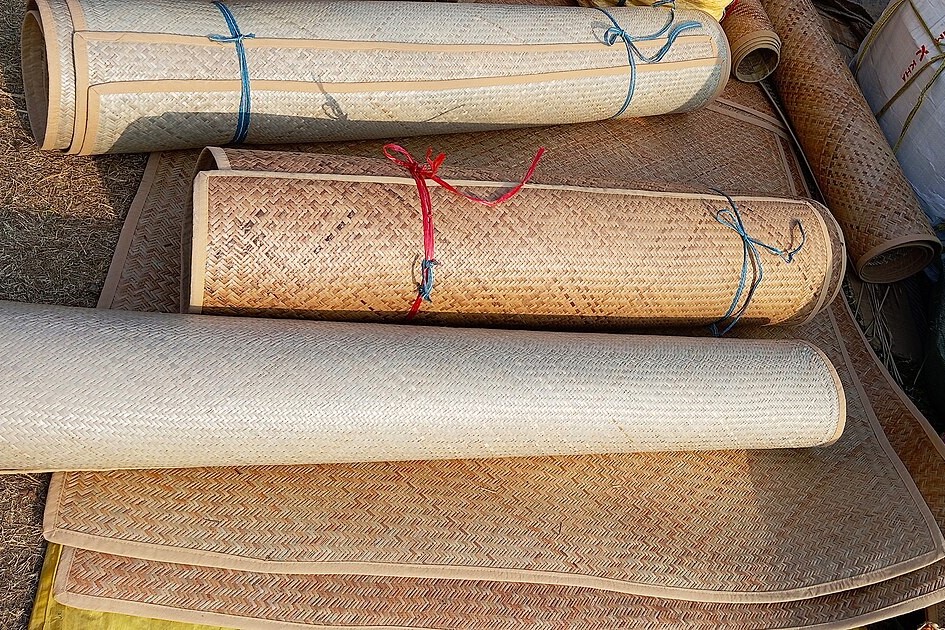
Shital Pati (literally "cool mat") is a traditional handwoven mat made from the green cane of the "Murta" plant (Schumannianthus dichotomus), which grows abundantly in the wetlands of Sylhet, Maulvibazar, and Habiganj districts in northeastern Bangladesh. The mat has a naturally cooling effect — when you sit or sleep on it, the surface remains significantly cooler than the ambient temperature, even without air conditioning. This property comes from the plant's high moisture content and the mat's porous, breathable weave.
The craft is highly specialized. Murta cane is harvested during the dry season (November-March), then split into ultra-thin strips (sometimes as fine as 0.5 mm) using a sharp knife. The strips are soaked in water, then dyed with natural colors (turmeric for yellow, indigo for blue, and tea leaves for brown). The weaving is done on a simple bamboo loom, but unlike cloth weaving, Shital Pati requires no horizontal weft thread — instead, the warp strips are interlocked diagonally in a complex herringbone or diamond pattern. A single medium-sized mat (6x4 feet) takes one artisan 7-10 days to complete.
The finest Shital Pati comes from the village of Karimganj in Sylhet, where families have practiced the craft for over 400 years. The mats are not just functional but also artistic — artisans weave intricate geometric, floral, and even Quranic calligraphy patterns. Historically, Shital Pati was a status symbol in Bengali households; wealthy families commissioned mats with silver or gold thread inlays. In 2017, Shital Pati received the Geographical Indication (GI) status from the Bangladesh government.
The GI tag protects "Sylheti Shital Pati" from imitations made in other regions using plastic strips or inferior cane. It has also boosted exports to Japan, South Korea, and Scandinavian countries, where natural cooling products are in high demand due to rising energy costs. However, the industry faces a crisis: younger generations are abandoning weaving because of low wages (an artisan earns only $2-3 per day). The government has set up "Shital Pati cooperatives" offering fair-trade certification, micro-loans, and direct market links to urban boutiques. Additionally, designers are now creating Shital Pati bags, wall hangings, and even lampshades to diversify beyond traditional mats. With innovation and fair pricing, this ancient craft can survive the 21st century.