
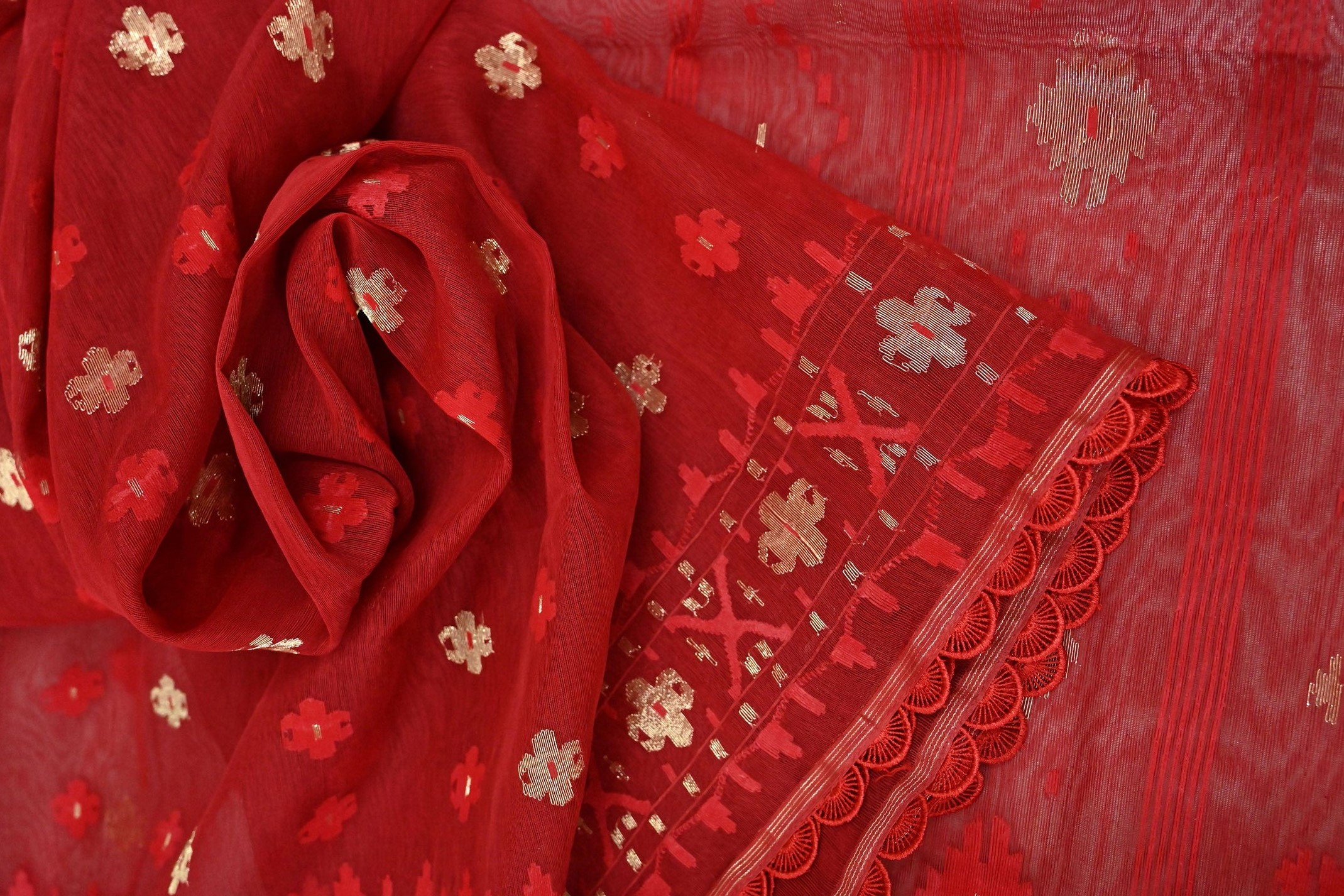
Jamdani is a centuries-old handloom weaving tradition of Bangladesh, famously known as the "woven air" due to its sheer texture and intricate motifs. Historically, Jamdani was a variant of the fine Muslin cloth that made the Bengal region famous worldwide, particularly during the Mughal era. The craft is primarily concentrated in the Shitalakhya river basin, especially in the Narayanganj district, just outside the capital, Dhaka.
The weaving process of Jamdani is exceptionally labor-intensive. It is a supplementary weft technique on a fine cotton base, where motifs are added manually by inserting discontinuous weft threads. Unlike other weaving methods, Jamdani requires two weavers — one on each side of the loom — to work simultaneously, creating complex floral, geometric, and paisley patterns. A single high-quality Jamdani saree can take from three months to a full year to complete.
The motifs traditionally draw inspiration from nature — flowers like jasmine (beli), rose (golap), and champa, along with leaves, vines, and even celestial bodies like the sun and moon. The base is unbleached cotton, but contemporary versions also feature colored borders (anchal) and gold or silver zari work. In 2013, Jamdani weaving was officially inscribed on UNESCO's Representative List of the Intangible Cultural Heritage of Humanity.
Bangladesh formally applied for the Geographical Indication (GI) status for Jamdani in 2015, and it was granted in 2016. This GI tag prevents other regions or countries from labeling their machine-made imitations as "Jamdani." Economically, the GI status has boosted exports, especially to Europe, Japan, and the Middle East, where Jamdani sarees are considered heirlooms. Despite facing competition from power looms, the handwoven Jamdani remains a symbol of Bangladeshi pride, worn by women during weddings, Eid festivals, and cultural events. The government has taken steps to support weavers through loans, training, and marketing platforms, ensuring this 2,000-year-old craft survives for future generations.